
French Treatise on Military Costume
- Author: Unknown
- Original Language: Middle French
- Place of Composition: France
- Date of Composition: 1446-1448 (according to section 15)
- Source of Text: René de Belleval (ed.), De Costume Militaire des Français en 1446 (Paris: Aug. Aubry, 1866) https://gallica.bnf.fr/ark:/12148/btv1b8426951w/ pp. 1-12 as transcribed at http://pfef.free.fr/Medieval/Unif_Org/CostMilFr.htm whose title is "Documents sur l'histoire militaire de l'Ancien Régime"
- Source of Translation: n/a
- Conditions of Use: Please acknowledge both de Belleval and http://pfef.free.fr/ for printing and transcribing this text. You may quote the translation in print or online if you acknowledge S. Manning at https://www.ageofdatini.info/fontes/french-treatise-military-costume.html
Around 1446-1448, someone in France began a treatise on how people at French courts dressed for war, jousts, and peace. The two known manuscripts only cover war and jousting with one paragraph and a missing illumination on civil costume. Because it has never been translated and says things which can also be learned by studying artwork and artefacts, it is much less known to English-speakers than French treatises on jousts and tournaments.
It was first printed by René de Belleval in 1866. He knew of two manuscripts: one which he owned, and another in the Bibliotheque nationale du France, MS. Français 1997 folios 63-80 https://gallica.bnf.fr/ark:/12148/btv1b9059047w/f36.item.zoom. I read two letters in item 4 differently from de Belleval's edition, but for now his text will do.
The only detailed study of this treatise which I know seems to start from the de Belleval text.
Reverseau, Jean-Pierre (1979), «L'habit de guerre des Français en 1446. Le manuscrit anonyme fr. 1997 de la Bibliothèque Nationale», Gazette des Beaux-Arts (Paris), vol. 93, n° 1324-1325, 1979, p. 179-198
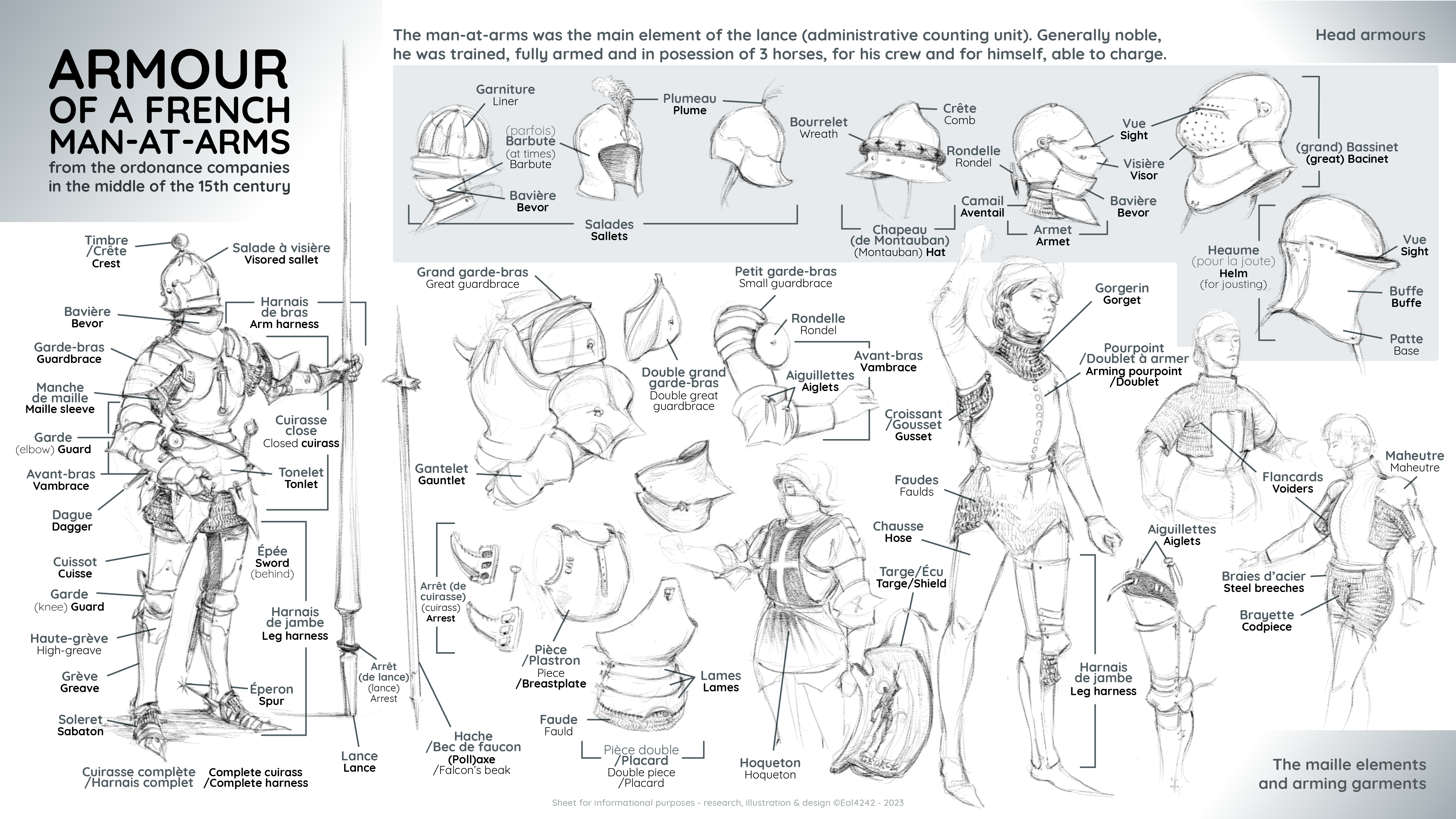
There is a brief discussion in Anglo's Martial Arts of Renaissance Europe pp. 210, 211 but he refers reades to Reverseau for details. There is an interpretation of the terms by @Eol4242 on twitter and at https://eol-art.fr/history/img/Armour%20of%20a%20French%20Man%20at%20Arms.png; thanks to Eldi for sharing an unpublished translation after I wrote mine.
In 1906 Antoine Thomas speculated that this anonymous treatise could be by the herald and writer Merlin de Cordeboeuf (thanks Théo Parla and https://fr.wikipedia.org/wiki/Merlin_de_Cordebeuf). I don't think he had good evidence, and Courdeboeuf was aligned with the Burgundians so might not have stressed the "kingdom of France" so much.
The manuscripts are divided into un-numbered paragraphs. I have added numbers and split some large sections into smaller parts such as 14a and 14b:
- Sections 1-2: introduction
- Section 3: the armour which men-at-arms wear to war
- Sections 4-6: three types of armour for the head
- Sections 7-9: two types of armour for the arms
- Section 10: two types of armour for the legs
- Section 11: archers (which in 15th century France can just mean "common infantry" armed with bows, crossbows, glaives, or lances)
- Paragraph 12: coustiliers (probably the same as the haubergeons in 14th century French sources: Steve Muhlberger - more Muhlberger - Will McLean)
- Section 13: swords and daggers
- Section 14: good and bad qualities of the French in war
- Section 15: for the clothes of men and women see the painting below (missing in both manuscripts) so I do not have to be prolix
- Section 16: the armour which is worn for jousting
- Sections 17-21: the helm
- Sections 22-24: the shield for jousting
- Sections 25-30: the harness for the body for jousting
- Section 31: a litte gardebras of one piece
- Sections 32-33: Armour for the right hand and arm
- Section 34: Legharness for jousting
- Section 35: Fastening the harness from below
- Sections 36-39: Lances for jousting
- Section 40: conclusion
I read at least one word differently than de Belleval did, but the text here is based on de Belleval as transcribed by http://pfef.free.fr/ I have normalized the spacing and punctuation and removed the pointers to de Belleval's foonotes. Anything in round brackets was added by me. Thanks to Fabrice Cognot for comments on the French.
| Original | Translation |
|---|---|
| (1) Icy après sensuit la façon comment les gens de guerre du royaulme de France, tant à pié comme à cheval, sont habillez en la manière et usance de le guerroier quilz font contre leurs ennemis. | (1) Here follows the fashion how the men of war of the kingdom of France, both on foot and on horseback, are dressed in the manner and usage of warfare which they wage against their enemies. |
| (2) Item aussi la faczon coment oudit royaulme tant hommes que femmes se habillent en vestemens aujourdhuy; desquelx habillemens passeray légièrement à les desclairer, pour ce que plus souvent que autres generacions rechangent voulentiers faczon de vesture; aussi après metray la manière de leurs dancez qui aujourdhuy court oudit royaulme de France, de leurs festoiemens, et aussi comment et en quelz harnoys ilz joustent. | (2) Item: Also, the fashion how both men and women of the said kingdom dress themselves in clothes today; which dress I will describe in brief, because they are more accustomed than other generations to change the fashion of their clothing at pleasure; also afterward I will put the manner of their dances which the court of the said kingdom of France (dance) today, of their festivities, and also how and in what harness they joust. |
| (3) Et premièrement, lesdiz homes darmes sont armez voulentiers, quant ilz vont en la guerre, de tout harnois blanc: c'est assavoir curasse close, avant-braz, grans gardebraz, harnois de jambes, gantelez, salade à visière et une petite bavière qui ne couvre que le menton. | (3) And first, the said men-at-arms are armed at their pleasure, when they go to war, in complete white harness: that is to say, closed cuirass, vambrace, pauldron (grans gardebraz), legharness, gauntlets, salet with visor, and a little bevor which does not cover more than the chin. |
| (4) Item, les aucuns portent différance en harnois de braz, de teste et de jambes; premièrement la différance du harnoys de teste, cest assavoir de biquoques et de chappeaulx de Montaulban. Et premièrement, les biquoques sont de faczon à que sur la teste, en telle forme et manière come ancienement les bacinez à camail souloient estre, et d'autre part vers les aureilles viennent joindre aval, en telle forme et faczon comme souloient faire les berniers. | (4) Item: Some of them carry different kinds of harness on their arms, head, and legs: first the different kinds of harness for the head, which is to say biquoques and hats of Montauban. And first, the biquoques are the kind which are pointed (ague) on the head, in the same form and manner as in former times the bascinets with camail were accustomed to be, and from either side next to the ears they come to join below, in the same form and fashion as they are accustomed to make (hats/helmets) from Berri (berriers). |
| (5) Item, et les chappeaulx de Montaulban sont rons en teste à une crefte ou meilleu qui vait tout du long, de la haulteur de deux doiz, et tout autour y a ung avantal de quatre ou cinq doiz de large en forme et maniêre dun chapeau. | (5) Item: and the hats of Montauban are round on the head with a crest in (ou) the middle which goes all along it, of the height of two fingers, and all around there is an aventail of four or five fingers in width in the form and manner of a chapeau (felt hat with a brim - ed.). |
| (6) Item, et la tierce armeure et la plus comune et la meilleure à mon semblant est l'armeure de teste qui se appelle sallades, car elles couvrent tout la plus part du coul derrière et toute la temple, loreille et la plus part de la joue, et davant couvre le fronc jusques au sourciz. En laquelle sallade y a une visière petite, laquelle visière quant elle est abessée recouvre les yeulx, le nés et la bouche; ainsi ne reste à couvrir que le menton et la gorge, et vient batre de lames jusques quatre ou cinq doiz sur la pièce de ladicte cuirasse bien gentement et à poinct. | (6) Item: and the third armour and the most common and the best, as it seems to me, is the armour for the head which is called salets, because they cover all the greater part of the neck in the rear and the whole temple, the ear, and the greater part of the cheek, and in front they cover the brow up to the eyebrows. On this salet there is a little visor, which visor when it is let down covers the eyes, the nose, and the mouth; and so nothing remains to be covered except the chin and the throat, and it comes to meet (the bevor) of lames up to four or five fingers above the piece (ie. breastplate) of the said cuirass very gently and properly. |
| (7) Item, quant à avant braz, il y en a de deux faczons come devant est dit; cest assavoir: les ungs et les plus comuns qui se font à Milan, qui se tiennent de pièces ensemble depuis la jointure de la main jusques à quatre ou à six doiz près la jointure de lespaulle hault. Et si vous me demandez de quantes pièces ilz sont faiz, je vous respons quil n'est ja besoing que je le déclaire plus particulièrement, car tout le monde le scet, et est si en usaige que ce ne seroit à moy que perdre parolles et temps: si non en tant que oudit avant-braz sénestre y a une garde dun pié en ront, façonnée presque en la faczon dun cueur, c'est assavoir la pointe couvrant le code et faicte en arreste, et l'autre partie contraire est ployée ou meilleu, laquelle ployeure couvre le plet du braz. Et quant le braz est ployé, ladicte garde couvre depuis le gantellet, ou à peu près, jusques au bort du garde-braz. | (7) Item: As for the vambraces, they are of two kinds as aforesaid: that is to say, the one and the most common, as is made at Milan, which is made up of pieces fastened together from the joint of the hand up to four or six fingers from the top of the shoulder joint. And if you want to ask me about how many pieces they are made of, I answer you that it is not necessary that I declare it more particularly, because all the world knows it, and it is so in use that it would not serve for anything except to waste words and time; except that on vambraces of this kind there is a guard of a foot in diameter (en ront), made almost in the shape of a heart, which is to say the point covers the elbow and makes it stop, and the other side opposite is bent in the middle, which bending covers the bend of the arm. And when the arm is bent, the said guard covers from the gauntlet, or thereabouts, up to the edge of the pauldron (garde-braz). |
| (8) Item, et l'avant-braz du braz droit est pareillement fait de pièces et couvre aussi hault le braz droit, come le sénestre avant braz fait le braz sénestre: mais la garde en est la moictié plus petite que l'autre, ne n'est pas faitte en ceste faczon du costé du coude come chascun scet, et oultre plus est depuis la ployeure du garde-braz contremont double, laquelle chose fut ordonnée pour le rencontre de la lance. | (8) Item: and the vambrace for the right arm is similarly made of pieces and covers as high on the right arm as the left vambrace covers the left arm: but its guard is half as big as the other, and it is not made in the same fashion on the side of the elbow as everyone knows, and in addition the other is double from the bend (of the arm) to the pauldron (garde-bras), which thing was ordained to encouter the lance. |
| (9) Item, lautre faczon davant-braz sont lesquelx sont faiz de trois pièces, cest assavoir une pièce qui couvre depuis la ployeure de la main jusques à trois doiz près la ployeure du braz ; et depuis la ployeure du braz y en a une autre qui vient jusques à hault de la joincture de lespaulle, à quatre doiz près. Pardessus lesquelles deux pièces y en a une autre qui couvre le code et la ployeure du braz et partie des autres deux pièces aussi, lesquelles trois pièces sont pareilles tant au braz droit que au sénestre; et se atachent avecques eguilletes. | (9) The other kind of vambrace are those which are made of three pieces, that is to say one piece which covers from the joint of the hand up to three fingers from the bend of the arm, and from the bend of the arm there is another which comes up towards the joint of the shoulder until it is only four fingers away. Atop these two pieces there is another which covers the elbow and the bend of the arm and part of the other two pieces as well, which three pieces are the same on the right arm as on the left; and they are attached with points (eguillettes). |
| (10) Item, quant au harnoys de jambes, l'une des faczons est clox davant et derrière par le bas, ainsi que on le faict à Millan, et à grandes gardes au genouil, et ung pou de mailles sur le cou du pié ; et l'autre faczon du harnoys de jambes est tout pareil à l'autre cy deffus déclairé, si non en tant que par la jambe bas s'en fault trois doiz que ne soit cloz, et ont les gardes plus petites endroit le genoil. | (10) Item, as for the legharness, one of the two kinds is closed in front and rear at the bottom, just as in those made at Milan, and had big guards on the knee, and a bit of mail at the ankle, and the other kind of legharness is in all ways alike the other as declared above, except that about the lower leg it is three fingers short of being closed, and the guards placed on the knee are smaller. |
| (11) Item, les archiers portent harnoys de jambes, sallades comme deffus est dict, gros jacques doublés de grant foyson de toylles ou brigandines, arc ou poing et la trousse au cousté: et ny use len point si communuement darbalestres comme ès autres lieux, excepté pour garder les places. | (11) Item, the archers carry legharness, sallets as is said above, big jacks doubled with a great many linens or brigandines, a bow in the hand and a sheaf (of arrows) at the hip: and they do not use arbalests as commonly as in other regions, except to guard the places. |
| (12) Item, y use len encores dune autre manière de gens armez seulement de haubergeons, sallade, gantellez et harnoys de jambe ; lesquelx portent vouluntiers en leur main une faczon de dardres qui ont le fer large, que len appelle langue de boeuf, et les appelle len coustilleux. | (12) Item, in addition they use another kind of men armed with just haubergeons, salets, gauntlets, and legharness; who prefer to carry in their hand a kind of dart which has a large head, which is called langue de boeuf or 'ox-tongue', and they call them coustilliers. |
| (13) Item, quant à faczon de dagues et d'espeez, tant de hommes darmes, de coustilleux, et d'archiers, sont ainsi que après sensuivent : premièrement, lesdiz hommes d'armes les portent courtes et pesantes, et sont d'estoc et de taille, et les dagues longues ; item, lesdiz coustilleux portent voluntiers fueilles de Catheloigne ung pou longuetes et estroites, et sont ung bien pou roides, et dagues pareilles ; item, les archiers les portent longues, tranchans come rasouers, et sont à deux mains, et ont dagues plus longues que les hommes d'armes ne les coustilleux, et tranchent aussi comme rasouers ; et portent arcs d'if et flèches de quatre palmes ou quatre palmes et demy de long et plus, et les fers à deux tranchans en forme de barbeleure. | (13) Item, when (we come) to the fashion of daggers and of swords, both of men at arms, and coustilliers, and of archers, they are also as here follows: first, the said men-at-arms wear them short and heavy, and they are cut-and-thrust, and the daggers long; item, the said coustilliers prefer to wear leaves of Catalonia a bit elongated and narrow, and they are fairly stiff, and similar daggers; item, the archers wear them long, sharp like razors, and they are two-handed; and the daggers are longer than those of men-at-arms and coustilliers, and also sharp like razors; and they carry bows of yew and sheaves of four palms or four palms and a half long or even more; and the heads have two edges with a bearded shape. |
| (14a) Item, en leur faczon de guerroier ont trois choses bien espécialles et de grant recomandacion pour toutes gens usans ou voulans user la guerre et exerciter leurs corps en armes : dont la première si est que lesdiz François sont de corps prompts entrepreneurs et assaillans leurs enemis sans bargigner ne marchander ; l'autre si est que en assaulx sont aspres combateurs et durs aux horions ; l'autre si est qu'il n'y a nul deulx ou vroiement la plus part qui naye bien couraige de valoir à combatre corps à corps aultruy de quelque nacion qu'il soit ; et sont volentiers gentement armez et plus apparaument et netement que autres nacions que soit. | (14a) Item, in their fashion for waging war there are three things very special and to be greatly recommended for all men making or wishing to make war and exercise their bodies in arms: of which the first is that the said French are ready entrepreneurs of their bodies and assault their enemies without hesitation or haggling; the next is that in assaults they are fierce combattants and hard to the end; the next is that there are hardly two of them or really most of them who do not have good courage and valour to fight body to body against any nation whatsoever; and they are gently armed at their pleasure and more conspicuously and neatly than other nations whatever they may be. |
| (14b) Mais plust à Dieu quilz fussent aussi obeissans à leurs chiefz et capitaines comme de leurs corps sont vaillans et habandonniez au péril de la fortune ; car, plus souvent leur prouesse sortiroit à fruit de victoire par la règle et moderacion de la raisonnable conduitte, et le labour de la peine de leur corps ne seroit pas si souvent en vain perdu ; car je ose bien dire et maintenir que tenir ordre et estre obeissant à son cappitaine doit estre repputé pour plus grant vaillance que monstrer la prouesse de son corps désordonnément oultre tout le comandement et ordonnance. Et à ce propos, trouverez en Titus Livius que les Romains faisoient plus aspre justice des transgresseurs leurs comandemens et ordonances par ardeur et vaillance de leurs corps, que des laches récréans et couars, et l'excécucion de Turcart contre son filz vaille ycy pour exemple. | But would to God that they were as obedient to their chiefs and captains as their bodies are valiant and given over to the peril of fortune; for their prowess would more often lead to the fruit of victory by the rule and moderation of the reasonable conduct, and the labour of the pain of their bodies would not be so often lost in vain; for I dare say and maintain that to keep order and to be obedient to his captain would be reputed of greater valour than to demonstrate the prowess of his body disorderly against all commands and ordonnances. And on this subject, you will find in Titus Livy that the Romans made harsher justice to the transgressors of their commands and ordinances by ardour and valour of their bodies, than to recreant and cowardly defecits, and the execution of Turcart (Titus Manlius Imperiosus) against his son is a worthy example of this. |
| (15) Item, après quant au fait des vestemens, tant des homes que des femes, pour non user de prolixité et non ennuyer de parolles, n'en décleray autre pour le présent, sinon que en l'an MIL IIIIc XLVI, XLVII, XLVIII, portoient tant gentilzhomes que gentilzfemes, en teste et sur leurs corps, la propre forme et faczon en telle manière comme cy davant est paint. Si me en tays atant, car par la painture le pourrez aussi bien comprendre, comme fi je le bailloye par escript. | (15) Item, after as to the making of clothing, both of men and of women, in order to not be prolix and not waste words, I will not declare anything other for the present, except that in the years 1446, 47, 48, both gentlemen and gentlewomen, on their heads and on their bodies, wear the proper form and fashion in that manner as is painted below. If I seem to pass over so much in silence, it is because they will be able to understand it as well from the painting, as if I had committed it to writing. |
| (16) Mais quant à la faczon de leur harnoys de jouste, suis content de le vous déclairer plus largement, affin que pour lavenir ceulx qui voudront jouster y preignent exemple, soit de y adjouster ou de y oster, comme mieulx verront et congnoisteront y estre néceffaire. | (16) But as to the fashion of their jousting harness, I am content to declare it to you at length, ... as many see and know to be necessary. |
| x | y |
| (22) Item, les escuz à quoy on jouste en France sont faiz de bois premièrement dun doy espès, et nervez tant dedans que dehors dun doy espès ou moins ; et sur ladicte nerveure par dehors est couvert de petites pièces larges et carrées du grant dun point deschiquier de tablier, qui sont faictes dos le plus dur que len peut trouver, et le plus comunément sont faictes de cornes de serf endroit la couronne, de lendroit proprement de quoy len fait les noiz aux arbalestres. | Translated on Shields, Targets, Pavises |
| x | y |
Edits
2024-03-08: fixed typos in clauses 14a and 14b, removed special
character <0xa0>
2024-03-10: small changes to translation of clauses 2, 4, 5
2024-03-18: decided to translate cou du pié as "ankle" not "bottom of the knee"
This site is free, but its not costless. Help keep it going with a donation on paypal.me, Patreon, ko-fi or Liberapay.


created and copyrighted on 2023-01-08 by S. Manning ~ last updated 2025-09-06